

Training an AI model on company data starts as a technical decision. Add a list of words employees should stop using, and it becomes a question about workplace culture, employee welfare and how concerns reach HR.
In this HR:ER scenario, that announcement leads to a public confrontation, an investigation within 40 minutes and a drafted resignation. The problems begin before anyone challenges leadership.
A language policy needs a clear purpose
Leadership announces a data-cleansing exercise. Staff should avoid words considered too aggressive, triggering or likely to bias the model.
Asking employees to moderate their language isn’t automatically unreasonable. The answer depends on which words are involved, where they’re being used and the existing workplace culture. Written correspondence also needs different consideration from everyday spoken conversation.
We discuss an unnamed tribunal case where an employee’s insult towards a manager didn’t justify dismissal for gross misconduct. Context mattered, including how people ordinarily spoke within the business.
But offensive language in work correspondence raises a wider concern. If your business considers certain words unacceptable for its model, there’s already a question about why employees use them at work.
Softening the words can hide the problem
The proposed replacements make that concern clearer. “Suicide” becomes “self-termination”. “Sexual assault” becomes an “unplanned sexual encounter”.
The second replacement removes something essential: consent. An unplanned encounter can be consensual. Sexual assault isn’t.
Our concern here centres on welfare and missed escalation, rather than an automatic finding of discrimination. Consider the example discussed in the episode: an employee asks a company chatbot what to do after experiencing sexual assault at work.
If the response talks about unplanned encounters, it can minimise what they’ve reported. If the system also fails to flag the concern, it may never reach HR.
Changing the language can also change whether a serious report reaches someone able to act.
During testing of our own AI support, the focus was on recognising matters that need experienced human input. Serious subjects need an appropriate escalation, not wording that makes the underlying issue harder to recognise.
An employee’s distress exposes the earlier failure
The next escalation describes a senior, well-respected colleague becoming upset and leaving the meeting.
Our view is that the process had already failed. Leadership had focused on changing behaviour to improve its model, without first addressing workplace culture, employee support or how sensitive messaging would land.
The motivation matters. A healthier workplace gives employees clearer standards and support. Asking everyone to behave differently for the model leaves those needs unresolved.
A manager challenges leadership in public
The colleague’s manager stands up and confronts leadership in front of his team.
His concern may be legitimate. His delivery may still need a conversation. Those points can both be true, without making immediate disciplinary action the right response.
Our first priority would be checking on the employee who left. The discussion with the manager would follow once the situation had settled.
That conversation would cover acceptable behaviour at company meetings, what he knew about his colleague’s welfare and whether concerns had previously been raised.
Senior leaders may not have known about those needs. That possibility deserves examination, alongside whether the business had made it difficult to raise them.
Walking away leaves the team without support
Afterwards, the manager’s team asks to speak with him. They say his intervention wasn’t helpful. He says he’s busy and leaves.
That creates another management concern. His direct reports still need support, and walking away sets a poor example.
Depending on the circumstances, refusing a reasonable management instruction could also become relevant. But the limited information doesn’t establish that this happened.
Our response would be to bring in another suitable person to settle the team and check on those affected. The manager would have time to cool off before a constructive discussion about his conduct.
An emotionally charged day needs careful handling. An aggressive disciplinary response could make it worse.
Forty minutes creates questions about the process
Around 30 minutes after the meeting, three people from human resources call the manager in. He’s told he created a hostile environment, a complaint has been made and a formal investigation is opening.
By roughly 40 minutes, the response already appears directed at him.
Opening an investigation quickly doesn’t establish that wrongdoing occurred. Here, the concern is the combination of speed, heightened emotions and language that appears to identify the manager as the problem before facts have been established.
Your disciplinary and grievance processes need room for that distinction.
The alternative discussed was a pause, potentially sending him home on pay to decompress, without treating that as suspension.
Protection depends on what he raised
Whether whistleblowing protection applies depends on the content of his comments and the circumstances.
A protected disclosure involves a reasonable belief in specified wrongdoing, such as a breach of legal obligations or health and safety risks, and must be made in the public interest. A personal grievance can contain a protected disclosure, even if the employee doesn’t use that term.
Victimisation raises a separate question: whether he carried out a protected act under the Equality Act, such as raising discrimination concerns, and suffered a detriment because of it.
Neither conclusion follows from speed alone.
The resignation email remains unsent
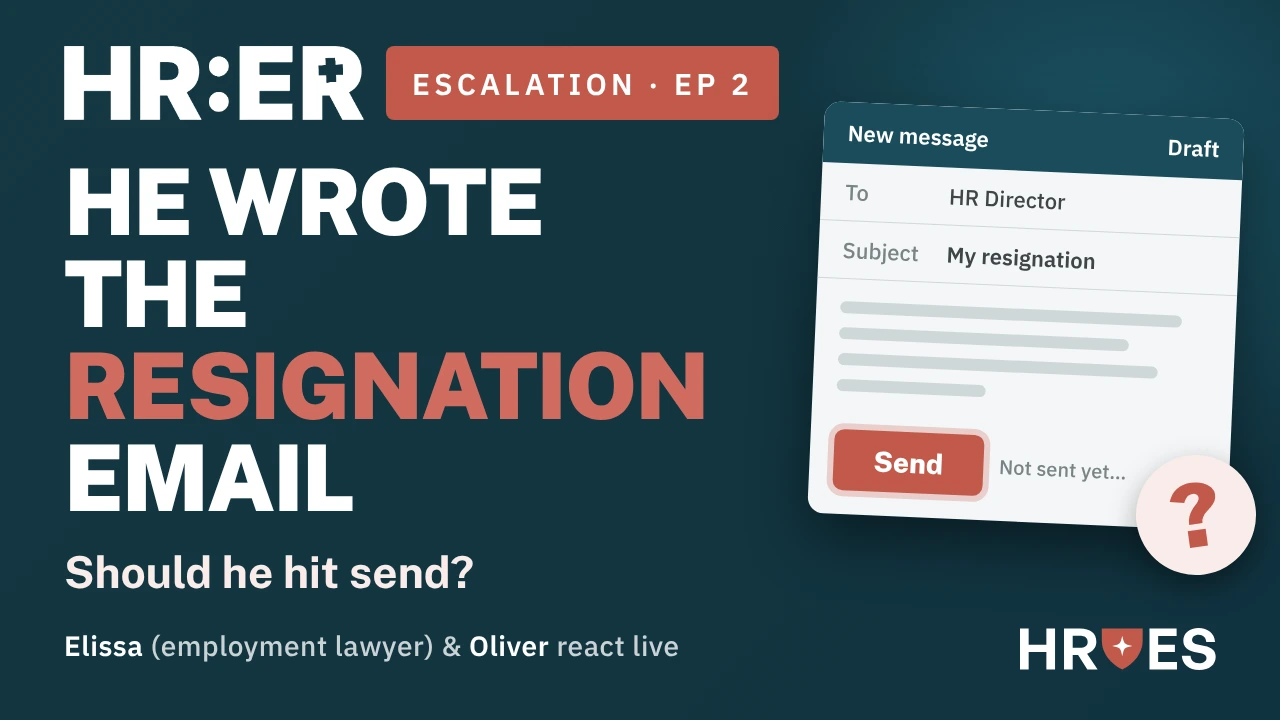
The final escalation places the manager at home with a drafted resignation email. His wife is telling him not to send it.
Our assessment is that resignation in response could raise a constructive dismissal argument, including a possible breach of trust and confidence. That’s a potential claim, not a guaranteed outcome.
We would normally expect an employee to raise a grievance first. But if HR appears to have reached its conclusion already, a tribunal may consider why the employee no longer trusted that route.
There’s another conditional concern. If an employer knows about an unsent resignation draft, how did it find out? That raises separate questions about email monitoring, including access to drafts.
Support needs to connect before matters escalate
The episode closes with the combination of training, software visibility, first-line support and experienced human advice. Each has a role before a difficult meeting becomes a legal dispute.
Our employment protection solution was created by award-winning employment lawyers. As employment law specialists, we bring HR software, learning, consultancy and tribunal cover together around employment risk management.
Book an intro call to discuss how that support fits your business.
The rollout was only the starting point
The AI announcement exposed concerns about language, welfare and culture. The response then added questions about fair process and trust.
The strongest lesson is about how the business responds. Checking on people, understanding the complaint and allowing emotions to settle would have left fewer problems to resolve.