

An HR risk assessment is a structured review of a business’s employment practices – contracts, policies, discipline, absence management and dismissal processes – used to identify where poor HR practice could lead to an employment tribunal claim, financial loss or reputational damage.
It scores each area of exposure so a business owner or HR lead knows exactly what to fix first, rather than discovering the gap when a claim lands.
If you run or manage people in a UK business, this guide covers what an HR risk assessment is, why it matters than ever before, the five areas every assessment should cover, and how to run one – including a free tool you can use today.
What is an HR risk assessment?
An HR risk assessment is a diagnostic exercise, not a compliance certificate. It looks at how a business actually manages its people day to day – not just what the employee handbook says – and flags where a gap between policy and practice could expose the business to legal or financial risk.
A good HR risk assessment typically evaluates:
- Whether employment contracts and written statements of terms are in place, current and legally compliant
- Whether policies (disciplinary, grievance, absence, equality) exist, are followed, and match current legislation
- How consistently managers apply process – because inconsistency, not the policy itself, is what tribunals penalise
- How well a business identifies problems early, before they escalate into formal claims
- Whether the business has evidence – a documented, defensible paper trail – if a decision is ever challenged
The output is usually a risk score or rating (for example, “elevated exposure”) alongside a prioritised list of fixes, similar to a health and safety risk assessment but applied to employment relationships instead of physical hazards.
Why HR risk assessments matter in 2026 and beyond
Employment tribunal risk has grown sharply for UK employers, and small and medium-sized businesses are carrying most of it.
- There are now roughly 523,000 open employment tribunal cases working through the system, and the backlog keeps growing.
- 71% of tribunal cases involve organisations with fewer than 50 employees – this is overwhelmingly an SME problem, not a large-corporate one.
- The maximum compensatory award for ordinary unfair dismissal rose to £123,543 (or 52 weeks’ pay, whichever is lower) for dismissals from 6 April 2026, with the statutory week’s pay cap up to £700.
- Discrimination awards carry no cap at all. Median awards for 2026 range from around £7,000 for race discrimination up to £13,000 for pregnancy and maternity discrimination – and the most serious cases run far higher.
- Day-one employment rights and tightening compliance requirements mean the margin for error has narrowed, especially for employers without dedicated HR or legal support.
The 5 areas every HR risk assessment should cover
1. Contracts & documentation. Missing, unsigned, or out-of-date contracts and staff handbooks are the most common – and easiest to fix – source of risk. If a policy hasn’t been updated since the law changed, it won’t protect you.
2. Disciplinary & grievance. Tribunals rarely penalise a business for making a difficult decision; they penalise it for handling that decision inconsistently or without following a fair process (the ACAS Code of Practice is the usual benchmark).
3. Discrimination & equality. Uneven treatment across protected characteristics – in recruitment, promotion, flexible working requests or dismissal – is the single largest driver of high-value, uncapped awards.
4. Absence & performance management. Long-term sickness, persistent short-term absence and underperformance are managed informally in most SMEs, which is exactly what makes them high-risk: informal usually means undocumented.
5. Dismissal & redundancy. The point where every other weakness surfaces. A procedurally flawed dismissal or redundancy process can turn an otherwise fair decision into a costly, defensible-in-name-only claim.
Common warning signs your business is exposed
- Contracts or handbooks that haven’t been reviewed in the last 12-24 months
- Line managers handling disciplinaries or grievances without HR or legal input
- No consistent, documented process for absence or performance issues
- High staff turnover, or a rise in informal complaints, with no clear paper trail
- No insurance-backed cover for tribunal defence costs or awards
- Nobody in the business can say, with confidence, “yes, we’d have evidence for that”
If two or more of these sound familiar, that’s a strong signal an HR risk assessment is overdue – not a distant priority.
How to carry out an HR risk assessment
Audit your documentation. Pull every contract, policy and handbook and check it against current legislation, not the version of the law that was true when it was written.
Review recent near-misses. Look at grievances, disciplinaries and exits from the last two years for patterns, not just outcomes.
Benchmark against the ACAS Code of Practice for the areas most likely to be scrutinised: discipline, grievance and dismissal.
Score each risk area – contracts, disciplinary/grievance, discrimination, absence/performance, dismissal/redundancy – so you can prioritise by exposure, not by whichever issue is loudest this week.
Build a prioritised action plan, and consider insurance-backed legal cover so a claim, if one does arise, doesn’t become a cash-flow emergency on top of an HR problem.
Take the free HR Risk Check
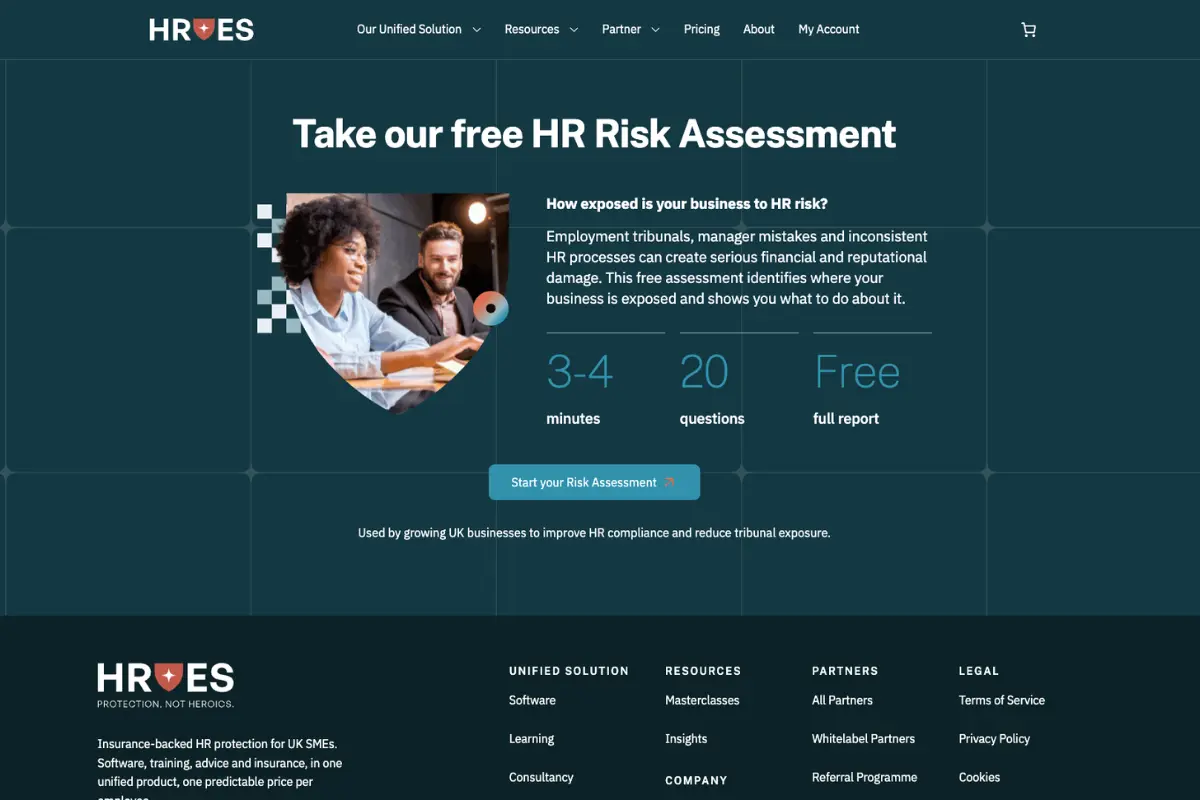
You don’t need to run this from scratch. HRoes’ free HR Risk Check is a 20-question, 3-4 minute assessment that scores your business across exactly the five areas above and generates a full report showing where you’re exposed and what to do next.
Free HR Risk Check – 20 questions, 3-4 minutes, instant score and full report.