“Just banter” is one of the most common phrases heard right before an organisation finds itself facing a grievance, an Employment Tribunal claim, or reputational damage.
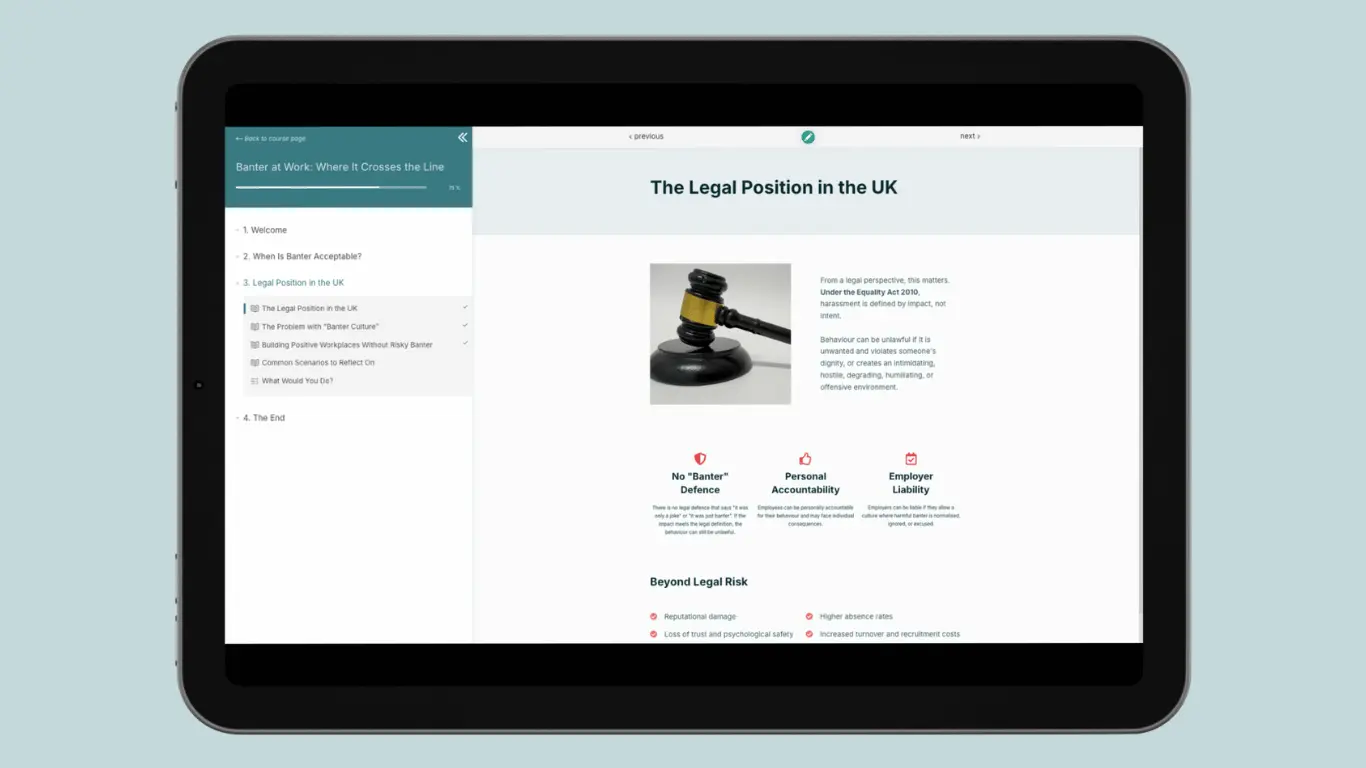
Workplace banter is not illegal by default – but when it crosses the line, it becomes a serious legal, cultural, and financial risk. Under UK employment law, particularly the Equality Act 2010, intent does not matter. Impact does.
This means employers can be held liable for:
- Comments they didn’t personally make
- Jokes dismissed as “harmless”
- Behaviour tolerated as “part of the culture”
- Actions of employees, managers, or team members
And crucially: there is no legal defence called “it was only a joke.”
Our free e-learning course is designed to help employers, managers, and employees recognise where banter becomes bullying, harassment, discrimination, or gaslighting – before it escalates into legal action.
What Is Workplace Banter – Really?
In many organisations, banter is described as:
- Team bonding
- Light-hearted teasing
- “Taking the mick”
- Part of being relaxed or informal
But in reality, “banter” is a catch – all label used to describe behaviours that can range from inclusive humour to exclusionary, humiliating, or intimidating conduct.
The same comment can be:
- Harmless to one person
- Deeply uncomfortable to another
In a workplace setting – where power dynamics, job security, and hierarchy exist – that difference matters.
The Legal Risk Employers Often Miss
Impact > Intent
One of the most dangerous misconceptions in the workplace is:
“I didn’t mean it like that.”
Legally, this does not matter.
Under the Equality Act 2010, harassment is defined by:
- Unwanted conduct
- The impact on the individual
- Whether it violates dignity or creates an intimidating, hostile, degrading, humiliating, or offensive environment
If an employee feels unable to challenge behaviour because they are junior, new, or different from the majority, the risk increases significantly.
How “Just Banter” Becomes a Tribunal Risk
Most tribunal cases don’t start with malicious intent. They start with defensiveness.
A familiar pattern:
- A comment is made
- Someone feels uncomfortable
- They speak up
- The response is:
- “You’re too sensitive”
- “Can’t you take a joke?”
- “That’s just how we are here”
At this point, banter turns into gaslighting.
Instead of addressing the behaviour, responsibility is shifted onto the person affected. Over time, this discourages reporting, entrenches poor culture, and creates exactly the evidence tribunals look for:
- Normalised harmful behaviour
- Failure to act
- A lack of psychological safety
Why Employers Are Liable for the Actions of Others
Many employers are shocked to learn they can be held responsible for:
- Comments made between colleagues
- “Unofficial” jokes
- Behaviour outside formal meetings
- Long-standing team cultures
If an organisation:
- Ignores complaints
- Excuses behaviour as banter
- Fails to train staff
- Allows managers to model poor conduct
It strengthens an employee’s legal case.
This course helps organisations demonstrate reasonable steps to:
- Prevent harassment
- Educate employees
- Challenge harmful norms
- Protect dignity at work
What the Course Covers
This free e-learning course provides clear, practical guidance on:
- What banter is – and what it isn’t
- When humour is acceptable at work
- How banter disguises bullying, harassment, and discrimination
- Why intent does not protect you legally
- How gaslighting shows up in everyday language
- Employer and employee accountability
- How to build positive workplace relationships without risk
Realistic scenarios and interactive questions mirror the exact situations that often end up in grievances and tribunals – making the learning immediately relevant and actionable.
Who This Course Is For
- Employers and business owners
- HR professionals
- Line managers and supervisors
- Team leaders
- Employees at all levels
Especially relevant for organisations that describe themselves as having a:
- “Banter culture”
- “Thick skin” environment
- Informal or fast-paced workplace
Why Training Matters
Most employers only invest in training after something has gone wrong.
This course removes the barrier:
- No cost
- No complex setup
- Immediate access
- Practical, legally grounded content
There is no reason not to equip your workforce with the knowledge that could prevent:
- Claims
- Investigations
- Reputational damage
- Loss of talent
You can enjoy unlimited access to our full suite of e-learning courses for 12 months for just £35. Bulk discounts are available for larger orders – get in touch to learn more.